Description

This course is registered for 1.2 ASHA CEUs (Intermediate level).
Course Description
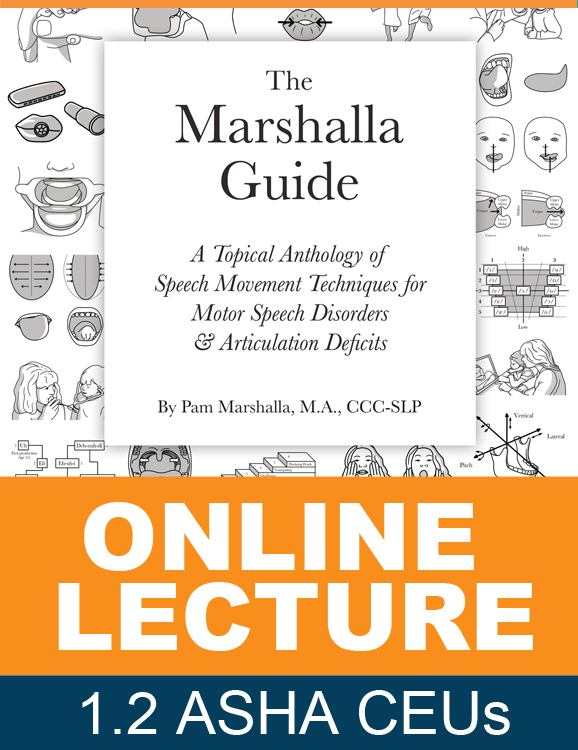
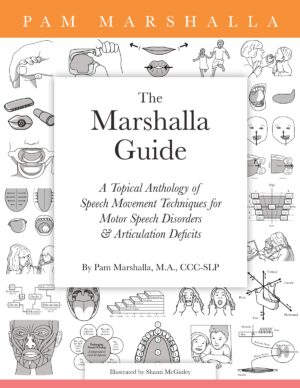
Take a deep dive into Pam Marshalla’s legendary work, The Marshalla Guide, through 12 hours of expert lectures for 1.2 ASHA CEUs. This self-paced online course is presented by six different renowned SLPs from the Oral Motor Institute.
Explore the foundational oral motor techniques detailed in Pam Marshalla’s book, The Marshalla Guide, learning the history, evidence for, and practice of modern motor speech training. Topics explored will be: the debate over non-speech oral motor exercises, infant oral reflexes, feeding, drooling, respiration, tactile cueing, and orofacial myofunctional approaches to therapy. The total course length is 12 hours over six lectures.
A generous portion of the proceeds for this course will be donated to the Oral Motor Institute, a registered non-profit organization. The OMI’s mission is to support the specialty of oral-motor-based therapy approaches that enhance the development of the orofacial complex and the functions of respiration, sleep, feeding, swallowing, and speech. The speakers for this course donated their lectures and time without receiving honorariums to further this cause. Pam Marshalla’s dream when she founded the OMI was to do what Board Chair Robyn Merkel Walsh is accomplishing today. Marshalla Speech & Language is excited to present such an astounding amount of information for therapists everywhere to have access to these perspectives. We thank the OMI board members for their time, expertise, and dedication to this field in undertaking this project.
Lectures
-
- The Evolution of Speech Pathology & Foundations of Articulation Therapy
By Robyn Merkel-Walsh, MA, CCC-SLP/COM® - Infant Oral Reflexes & Feeding Concerns: A Neurodevelopmental Perspective
By Debra Beckman, MS, CCC-SLP - Drooling: Practical Solutions for Home and Therapy
By Lori L. Overland, MS, CCC-SLP, C/NDT, CLC, FOM - Breath Support for Speech Production
By Kaitlyn Shrum, MA, CCC-SLP, QOM, CMT, cert BBM - The Changing Landscape of Sensory-Based Speech Teaching Using Tactile Cueing Techniques
By Renee Hill, MS, CCC-SLP, CLC, Certified: Orofacial Myofunctional Disorders (2019, #329-C-19, IAOM) - The Orofacial Myofunctional Component in Diagnostics and Treatment of Speech Movement Patterns
By Mary Billings, MS, CCC-SLP, Certified: Orofacial Myofunctional Disorders (2009, #151)
- The Evolution of Speech Pathology & Foundations of Articulation Therapy
Course Details
- Twelve-hour online video seminar accessed here at PamMarshalla.com
- Available for 1.2 ASHA CEUs and/or 12 state CE credit/hours
- Appropriate for SLPs – Content Code: Professional, Instructional Level: Intermediate
- Self-paced course: Take classes on demand at your leisure and register for CE credit when you’re done
- Quizzes after each two-hour video lecture; progress saved as you go
- Lifetime access to the course through your account here on our website
- Register to receive ASHA CEUs and/or a certificate of completion online here after completing the course
Satisfactory Completion
To complete this self-study course and earn ASHA continuing education units (CEUs), learners must watch all seven lecture videos in full (total of 12 hours) and complete a short quiz at the end of each video. Videos can be paused and course progress can be saved and continued over a period of time. At the end of the course, participants must submit a simple evaluation of the course, which can be accessed in the same registration forms used to receive a certificate of completion and ASHA CEUs once the participant has viewed the entire course. Access to the enrollment forms for CEUs can be found on our website under the menu Continuing Education.
No ASHA?
If you do not wish to receive ASHA CEUs for this course, we are happy to give you only a certificate of completion after you watch the video — you can opt out of ASHA reporting when you submit your registration paperwork to us online.
Group Learning
This course can be taken as a group by purchasing multiple counts of this lecture at the same time. Once you have made your purchase, please email us with your order number and a list of names and email addresses for all of the participants. We will create individual logins for each participant and communicate with you about the process as we get your group set up.
Groups can then watch the videos together using one account (hooked up to a screen, etc.) but then each participant can take the quizzes individually at the end of each video using their own devices on their own accounts.
After completing the course, each participant can individually record their participation in the course and receive their certificate of completion and ASHA CEUs (and/or state CE hours) by filling out a CE Enrollment Form on our website.
Lecture Details & Learning Outcomes
The Evolution of Speech Pathology & Foundations of Articulation Therapy
By Robyn Merkel-Walsh, MA, CCC-SLP/COM®
This course explores the historical and scientific foundations of articulation therapy, tracing the evolution of speech pathology from its origins in ancient Greece and Rome to the modern evidence-based practices of today. Inspired by Pam Marshalla’s The Marshalla Guide, this course provides a comprehensive overview of speech movement techniques and the principles of traditional articulation therapy, and an overview of solutions that are applicable to those who do not respond as expected due to structural and/or motor-based deficits.
Participants will examine the transition from elocutionists to contemporary speech-language pathologists, analyzing key milestones such as the introduction of phonetic placement, the International Phonetic Alphabet, and the development of the phonetic placement approach Van Riper. Through a blend of historical context, clinical application, and research-based strategies, attendees will gain a deeper understanding of how articulatory precision, posture, and gesture contribute to speech intelligibility.
A critical discussion will address the ongoing debate surrounding non-speech oral motor exercises (NSOME), clarifying their distinction from evidence-based speech movement techniques. Additionally, the course will emphasize structural integrity, muscle tone, and motor planning as essential components of speech development and remediation. By integrating traditional articulation therapy with contemporary research, clinicians will learn to enhance speech clarity, even in the most unintelligible clients.
Learning Outcomes
By the end of this course, participants will be able to:
-
-
- Define elocution within its historical and modern context.
- List at least two rules of intelligible speech.
- Describe the difference between a non-speech oral motor exercise (NSOME) and a phonetic placement technique.
-
Infant Oral Reflexes & Feeding Concerns: A Clinical Deep Dive
By Debra Beckman, MS, CCC-SLP
Feeding problems are often one of the earliest signs of neurodevelopmental vulnerability, yet many clinicians report limited training in how oral reflexes organize feeding, swallowing, and later motor control. This 120-minute prerecorded course provides speech-language pathologists and occupational therapists with a clear, evidence-based framework for understanding infant oral reflexes as developmental organizers, not isolated responses. Drawing on fetal, neonatal, and postnatal research, participants will learn how reflex patterns relate to feeding readiness, coordination, and risk for later feeding impairment. Rather than teaching reflex “exercises,” this course emphasizes clinical observation, interpretation, and referral decision-making within scope of practice. Case examples are used to demonstrate how reflex persistence, coordination, and integration patterns inform feeding assessment and interdisciplinary collaboration. Participants will leave with a stronger ability to recognize red flags, interpret feeding behaviors through a neurodevelopmental lens, and understand how structured oral motor assessment supports clinical reasoning across settings including early intervention, NICU follow-up, outpatient feeding, and pediatric dysphagia.
Learning Outcomes
By the end of this course, participants will be able to:
-
-
- Describe the developmental role of infant oral reflexes in organizing feeding, swallowing, and early neuromotor control.
- Differentiate typical reflex integration patterns from clinically concerning persistence or incoordination that may impact feeding development.
- Apply oral reflex observations to inform feeding assessment, referral decisions, and interdisciplinary collaboration within professional scope of practice.
-
Drooling: Practical Solutions for Home and Therapy
By Lori L. Overland, MS, CCC-SLP, C/NDT, CLC, FOM
Drooling is developmentally appropriate during early teething. However, drooling that begins around three months of age and persists beyond the toddler years may indicate underlying medical or social concerns. Pam Marshalla addressed this issue in her 2001 publication How to Stop Drooling: Practical Solutions for Home and Therapy.
This introductory-level course explores the production and purpose of saliva, as well as the challenges that contribute to chronic drooling. Pam Marshalla’s fundamental foundations and behavioral approach to therapy are discussed. Building upon her work, the course also presents a modern, evidence-based literature review on strategies to decrease pooling of oral secretions and drooling. Guidelines for motivation and habituation to reduce and eliminate drooling, as well as strategies for addressing drooling both at school and at home, are included.
Learning Outcomes
By the end of this course, participants will be able to:
-
- Define drooling.
- List at least four of Pam Marshalla’s fundamental keys to addressing drooling.
- Identify at least four strategies to decrease drooling and habituate control of oral secretions.
Breath Support for Speech Production
By Kaitlyn Shrum, MA, CCC-SLP, QOM, CMT, cert BBM
This course explores the importance of our most fundamental speech movements, inhalation and exhalation. Breathing is the body’s most basic need and the primary source of energy for speech production. Using The Marshalla Guide along with various breathwork techniques, this course provides an introduction to functional breath support for speech production. Participants will review the anatomy of respiration, understand functional versus dysfunctional breathing patterns, assess breathing patterns in relation to speech production, and learn techniques to improve functional breathing in a clinical setting.
Learning Outcomes
By the end of this course, participants will be able to:
-
- Label the anatomy of respiration.
- Describe the components of breath support for speech production
- Explain functional versus dysfunctional breathing patterns for speech production.
The Changing Landscape of Sensory-Based Speech Teaching Using Tactile Cueing Techniques
By Renee Hill, MS, CCC-SLP, CLC, Certified: Orofacial Myofunctional Disorders (2019, #329-C-19, IAOM)
For years, therapists have utilized a wide range of cueing systems to teach phonemes, syllables, and words, each with its own unique techniques. Some methods have emerged from therapists’ adaptations when working with clients who do not respond to traditional approaches, while others have been formally developed and taught. However, few have been extensively researched. Many clinicians integrate multiple strategies to tailor their approach to each individual client’s needs. Pam Marshalla, a leading speech-language pathologist in treating articulation disorders, emphasized that “an adequate perception of the mouth and its movement capabilities is necessary to develop mature speech.” This course will explore the key cueing systems that she found most effective in clinical practice.
Participants will gain an understanding of how foundational knowledge in movement development can guide the selection of appropriate cueing strategies, particularly for individuals with motor speech disorders. A discussion on tactile approaches will encourage participants to explore alternative methods for facilitating speech. The course will introduce the ”Motokinesthetic Method”, one of the earliest formal speech movement training systems, while also examining current tactile cueing techniques. Emphasis will be placed on identifying whom these approaches benefit and how they contribute to speech clarity development.
Learning Outcomes
By the end of this course, participants will be able to:
-
- Describe at least three cueing systems used to facilitate speech production, including the Motokinesthetic Method and a tactile cueing approach.
- Match appropriate cueing strategies to at least three client profiles with motor speech disorders based on principles of speech movement learning.
- Explain the role of oral perception in speech development and identify two tactile methods that can enhance speech clarity.
The Orofacial Myofunctional Component in Diagnostics and Treatment of Speech Movement Patterns
By Mary Billings, MS, CCC-SLP, Certified: Orofacial Myofunctional Disorders (2009, #151)
For years therapists have developed a variety of clinical methodologies and approaches when working with clients who do not respond to a traditional articulation approach. Most involve utilizing multiple strategies adapted to the individual needs of the client.
Speech is Movement. Pam Marshala emphasized that “stimulating the biological foundations of articulation” is a necessary a logical approach to facilitating articulation improvement. In this course participants will gain a basic understanding of how underlying orofacial myofunctional disorders often lead to disruption of those developing motor patterns.
This course will review the foundational purpose of the orofacial complex (breathing and swallowing) and its overlying functions. Participants will learn how critical early development of motor patterns that involvesucking, swallowing and chewing are foundational for the development of future motor speech patterns. Participants will learn how to view the functional systems of the orofacial complex when performing a comprehensive evaluation and how critical cranial/dentofacial growth patterns may inhibit development or reinforce adaptative patterns. Principles of proprioceptive neuromuscular facilitation (PNF) will be reviewed supporting how it can be an effective approach to orofacial myofunctional and motor speech disorders.
Learning Outcomes
By the end of this course, participants will be able to:
-
- Define an orofacial myofunctional disorder.
- Identify the primary functions of the orofacial complex.
- Name five of the functional systems of the orofacial complex.
- Explain how the principles of proprioceptive neuromuscular facilitation (PNF) effect motor changes and name three different PNF methods.
Disclosures
Debra Beckman is the owner of Beckman & Associates, Inc. Pediatric Therapy Clinic. She receives revenue from products and professional activities related to the Beckman Oral Motor Approach, including sale of the following products: Beckman Tri-Chew, Beckman E-Z Spoon, and Beckman Professional Oral Probe, as well as from the sale of her books Alligator Alphabet and Alligator Alphabet Tracing and Coloring Book. Debra is the originator of the Beckman Oral Motor Assessment and Intervention Approach and provides training to therapists world wide regarding Beckman Oral Motor techniques. She is a lifetime member of ASHA, member of FLASHA, and a board member of both Learn Autism and the Oral Motor Institute.
Mary Billings is the owner of both Billings Speech Pathology Services and Elevated Therapeutics where she receives an honorarium as a paid speaker, mentor and business coach. Mary is the secretary for the Oral Motor Institute. She is a lifetime member of ASHA, member of AAPMD, member of WDDS, and past president of the IAOM.
Renee Roy Hill receives income from and is the owner of Crossroads Therapy Clinic. She is a member of the TalkTools® speaker bureau from which she receives speaker honorariums for her courses and royalties for products she has developed. She is a Board Member of the Oral Motor Institute and member of ASHA and TSHA.
Robyn Merkel-Walsh receives income from her many professional roles: faculty with the Ridgefield Board of Education, guest faculty at The Breathe Institute, adjunct professor at Brescia University, author and consultant at TalkTools®, and owner of Diamond Myo and Vocology. Robyn is the Board Chair at the Oral Motor Institute; a member of ASHA, NJEA, ICAP, NJSHA, AAPPSPA, AAPMD, and IAOM; the CE Coordinator at Marshalla Speech and Language; and Ambassador for TBI.
Lori Overland is a member of the TalkTools® professional enhancement team from which she receives income as honorariums for teaching and royalties for books published. She is the owner of Alphabet Soup Pediatric Oral Sensory Motor Feeding and Speech Therapy and co-owner of Mouths in Motion Mentoring Service. Lori is a Board Member of the Oral Motor Institute; Ambassador for the Breathe Institute; member of ASHA, LISHA, NYSSLHA, and CSHA; and member of ICAP and IAOM.
Kaitlyn Shrum is the owner of Southern Speech and Myo and Breathe Strong. She receives financial compensation from sales of her book, Frankie Goes to Camp; from mentoring services; and from her course, Just Breathe: Breathwork for Myofunctional Therapy. She also receives compensation for professional services provided to Northern Speech Services, The Myo Membership, and Sonu Health. Kaitlyn serves as a board member for Orofacial Myology International, the Oral Motor Institute, and the North Florida Airway Health Association.
Marshalla Speech & Language (MSL) is the publisher and presenter of this course, from which revenue is gained. MSL is also the publisher of the book The Marshalla Guide which is the source material referenced throughout this course. This publisher has no non-financial relationships to disclose.
ASHA CE Registry & Fee
To earn ASHA CEUs, subscribers must have paid their annual ASHA CE Registry fee. Individuals must meet at least one of the following conditions to be eligible to earn ASHA CEU:
- ASHA Member (includes Life member and International affiliates)
- ASHA Certificate of Clinical Competence (CCC) Holder
- Licensed by a state or provincial regulatory agency to practice speech-language pathology (SLP) or audiology
- Credentialed by a state regulatory agency to practice SLP or audiology
- Credentialed by a national regulatory agency to practice SLP or audiology
- A Clinical Fellow supervised by someone who holds the ASHA CCC
- Currently enrolled in a master’s or doctoral program in SLP or audiology
The participant pays ASHA CE Registry fee directly to the ASHA National Office. The annual ASHA CE Registry fee allows registration of an unlimited number of ASHA CEUs for the calendar year. Contact the ASHA CE staff at 800-498-2071 or visit http://www.asha.org/ce/CEUs for CE Registry fee subscription information.
Reviews
There are no reviews yet.